What Self-Insured Employers Need to Know About GLP-1 Drug Costs in 2026
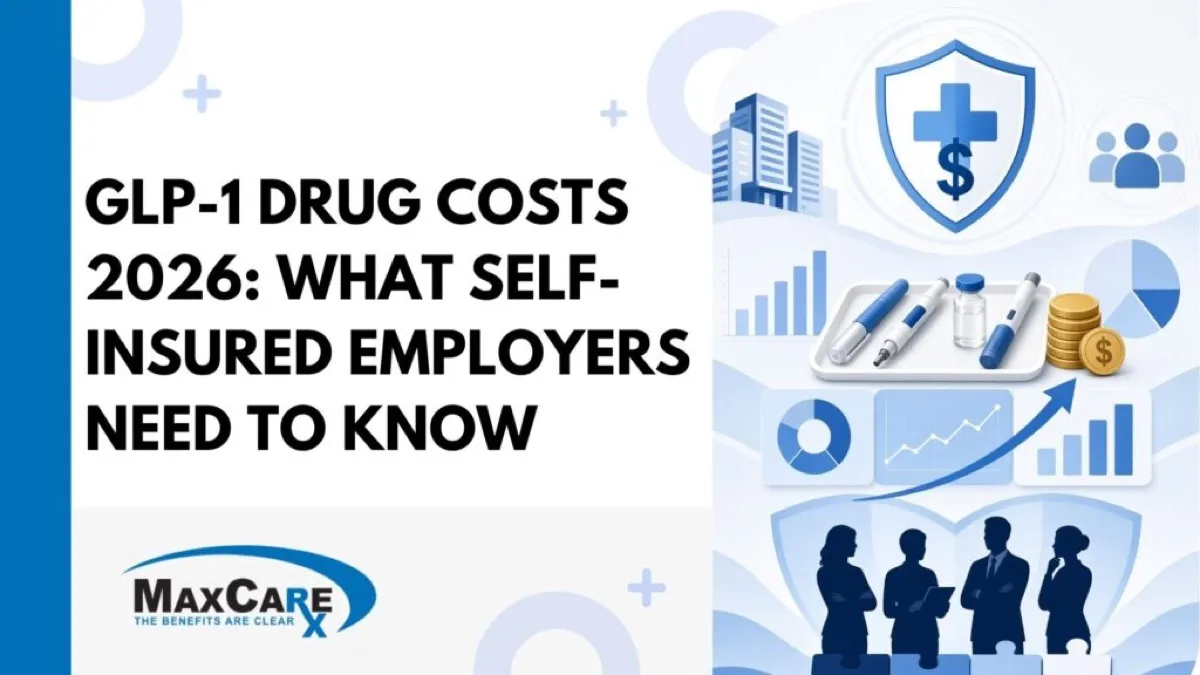
GLP-1 medications, including semaglutide (Ozempic, Wegovy), tirzepatide (Mounjaro, Zepbound), and others, have become the fastest-growing cost driver in employer pharmacy benefits. For self-insured employers, the question is no longer whether GLP-1 drugs are affecting your pharmacy budget. The question is whether you have the right tools to manage that impact without restricting access to medications your employees need.
Here is what the data shows, and what transparent pharmacy benefit management looks like when GLP-1 costs are on the table.
The GLP-1 Cost Reality for Self-Insured Employers
The list price of GLP-1 injectable medications runs from $900 to $1,400 per month before any discounts, rebates, or plan negotiations. For a self-insured employer with 500 covered lives, even modest GLP-1 utilization can add $500,000 or more to annual pharmacy spend, and that figure compounds as utilization grows.
Several factors are driving this acceleration:
- Expanded clinical indications: GLP-1 drugs were originally approved for type 2 diabetes management. They now carry FDA approvals or pending approvals for weight management, cardiovascular risk reduction, metabolic dysfunction-associated steatohepatitis (MASH), sleep apnea, and chronic kidney disease. As indications expand, so does the eligible patient population on your plan.
- Media attention: Consumer demand for GLP-1 medications has risen dramatically alongside mainstream coverage of their weight loss effects. Employees are asking their physicians for prescriptions, and physicians are responding. Formulary restrictions that were manageable two years ago are now generating member complaints and HR escalations.
- Rebate dynamics: Large national PBMs market GLP-1 rebates as a major offset to cost, but rebate economics in this category are more complex than they appear. Rebate structures are negotiated at the formulary level, preferred agents shift, and the portion of rebates that actually flow to your plan depends entirely on your contract. If you have a traditional PBM that retains a percentage of rebates, GLP-1 spend is a category where that retention adds up fast.
What Pass-Through Pricing Changes for GLP-1 Management
A pass-through PBM operates differently. MaxCare passes 100% of drug discounts and 100% of manufacturer rebates directly to your plan: no holdbacks, no retained spread. In the GLP-1 category specifically, this means:
Every rebate negotiated on a preferred GLP-1 agent goes back to your plan rather than subsidizing PBM margin. For employers with meaningful GLP-1 utilization, this structural difference can represent tens of thousands of dollars per year in savings that traditional PBM contracts simply do not deliver.
But pass-through pricing alone is not a GLP-1 management strategy. Cost transparency is necessary, but it is not sufficient. The real levers are clinical.
A Clinical Approach to GLP-1 Cost Containment
Effective GLP-1 management for self-insured employers requires a program that combines three elements: formulary design, utilization management, and member engagement.
1. Formulary Design
Not all GLP-1 agents carry equal rebate performance or clinical outcomes data for a given indication. A formulary built around clinical evidence and rebate optimization, with appropriate step therapy for weight management indications, can reduce average per-patient cost without restricting access for members with medically appropriate need.
2. Prior Authorization and Step Therapy
Clinical prior authorization for weight management indications (as distinct from diabetes management) is an established best practice. Requiring documentation of a qualifying BMI, a co-morbid condition, and a failed lifestyle intervention before GLP-1 approval for weight loss is clinically defensible and cost-effective. MaxCare’s utilization management team reviews these cases proactively, before a claim compounds into a budget problem.
3. Manufacturer Coupon Management
Members who are commercially insured often qualify for manufacturer savings programs that reduce their out-of-pocket cost and shift the burden away from the plan. MaxCare’s specialty coupon management program identifies eligible members and coordinates benefit assistance, reducing plan liability on high-cost GLP-1 claims.
4. Concurrent Drug Utilization Review (DUR)
Real-time DUR catches clinical red flags, such as GLP-1 prescriptions without documented indications, potential duplicate therapy, or dosing outside approved parameters, before the claim is paid rather than after.
What to Ask Your Current PBM About GLP-1 Costs
If you are reviewing your pharmacy benefit arrangement, the GLP-1 category is a useful diagnostic. Ask these questions:
- What percentage of GLP-1 rebates does the PBM retain versus pass through to my plan?
- What is my per-member-per-month GLP-1 cost, and how does it benchmark against peer employers?
- Does the PBM’s prior authorization criteria for weight management GLP-1 use align with clinical guidelines?
- Is the formulary’s preferred GLP-1 agent chosen based on clinical evidence, rebate economics, or the PBM’s own financial relationships with manufacturers?
If the answers are not clear, direct, and documented in your contract, that opacity has a cost.
MaxCare’s GLP-1 Management Program
MaxCare’s clinical team manages GLP-1 utilization as part of our comprehensive specialty cost containment approach. Our program includes formulary optimization for diabetes and weight management indications, proactive prior authorization review, manufacturer coupon coordination, and concurrent DUR, all operating on a fully transparent, pass-through model where every rebate and discount flows back to your plan.
We will show you exactly what your GLP-1 spend looks like today, benchmark it against comparable employers, and model the impact of clinical and formulary interventions before you commit to any changes.
The fastest-growing cost category in pharmacy benefits deserves a management strategy that is at least as transparent as the problem it is solving.
Ready to benchmark your GLP-1 costs? Request a Pharmacy Spend Analysis → https://www.maxcarerx.com
MaxCare RX is an independent pharmacy benefit manager headquartered in Oklahoma City, Oklahoma. MaxCare operates on a full pass-through model: 100% of drug discounts and rebates go directly to your plan. Call: (800) 259-7765 | Address: 933 E Britton Rd, Oklahoma City, OK 73114